You can say “care” in Mandarin in many ways–zhaogu, kanhu, zaihu, and of course, guanxin. I have an example of guanxin.
My husband and I purchased a used monitor on an online marketplace and agreed to pick up the monitor from the seller at the subway stop. With Cristian carrying the monitor, we waited for a bus to take us back to the apartment. This particular stop has a dizzying array of buses of various sizes with different labels–Red12, 645, 902, 612, Red 11, buses with no numbers but destination names, a bus that takes you to the hospital–a total of 20 or so buses go through this area. The photos below show the same screen scrolling through the buses and their arrival times.
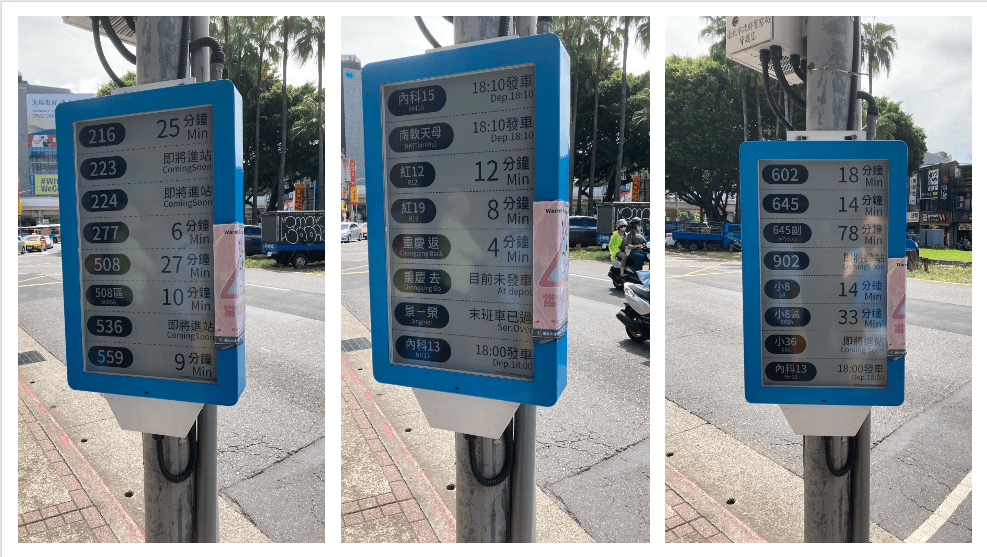
Since it’s August in Taipei, it is still sweltering hot and humid at 8 pm. A bus that has 600 something on it is stopping by, and Cristian says, “This looks like the bus we took yesterday. Should we get on it?” As a cosmologist who works with really big numbers, he often says, “It’s within a margin of error.” While a part of me thought this was suspicious, another part of me (and the part that won out) thought, “Let’s do it so I can cool off in the air conditioned bus. If we end up lost, we can always take a taxi.”
Once on the bus, the machine rejects Cristian’s card because he has run out of money. Yet he keeps swiping it, and the REJECT beep rings several times throughout the bus. It is alarming. Will we have to go back into the sweltering heat? Luckily, I have one of my children’s cards and swipe for him. Oddly, he keeps swiping his card. Finally, I hold up my two cards for the bus driver and tell Cristian that I have swiped for him. As we make our way to the back of the bus, he repeats, “Why didn’t you tell me you swiped for me?” and I keep repeating, “Didn’t you see me swipe two cards?” We are bickering like an old couple–wait, we already are an old couple.
We sit facing the back row of passengers. Soon enough, I realize that the bus is not taking us on the same route. I look at the people sitting directly across from us and a third person sitting by the opposite window. They are slouched into their seats, lost in their own worlds. Not wanting to disturb their thoughts but also not wanting to get lost, I muster some energy to ask if this bus will take us to the Taipei American School. The man across from me sits up and says yes. I then ask if they will tell us when we should get off the bus, and the woman sits up and says yes with much energy. It is as if we are doing a trust fall, and she is ready to catch us. Since it’s hot, I wanted to be more precise–that we actually lived close to the Taipei American School. The woman asks for our address and starts typing it into her phone. By now the man and woman are invested in our dilemma.
Suddenly, the woman says, “You get off here.” We thank them and get off the bus. As I look around, the area does not look familiar, and my confusion must have shown. Next, my eyes widen as I see three arms point vigorously IN UNISON toward the direction of the school and the concerned faces of the elderly man, middle-aged woman, and the youth (who must have listened intently to our conversation) turned toward us as they sit straight in their seats. As the bus rolls away, Cristian points to some landmarks, and we are to walk in the opposite direction. Because the bus passengers’ guanxin (pronounced guan shin) was so palpable (and “shin” is the character for “heart”), I tell Cristian, “I hope they didn’t see us go in the opposite direction. They might lose sleep!”
