There she was—a little girl with two ponytails sticking out of the sides of her head, sitting on the ground with air purifiers humming around her, gazing wistfully out her apartment window. She couldn’t go outside that day. Or the next. The air was too dangerous to breathe. This scene in the 2015 documentary “Under the Dome” made me realize how fortunate I was to live in rural upstate New York.
The documentary reminded me of my visit to Beijing in 2008. I had asked a taxi driver about not seeing the blue sky during my entire stay, to which he confidently replied that it was just a cloudy stretch. And because I had arrived two months before the Beijing Summer Olympics were to begin, the capital was implementing extraordinary measures to make its sky blue, conducting cloud experiments and stipulating that cars with even-numbered license plate numbers drive on certain days and odd-numbered ones on others.
Since my family and I breathe camp-fresh air every day, I thought about how much I would pay to ensure that my children could breathe this air—$25 a day, $100 a day? It had never crossed my mind to worry about my children breathing in PM 2.5 particles that would wreak havoc inside their bodies. Fresh air was a priceless, invisible, taken-for-granted resource that supported my work-family balance—I didn’t have to monitor air quality every day, invest in expensive purifiers, change air filters, ensure that my children wore masks on bad days or keep them indoors, all the while being concerned about potential lung issues.
While in Taiwan, I stumbled across another such resource––it was so invisible that I couldn’t put my finger on it for several weeks. I needed to see it in action, juxtaposed to what I knew in the United States.
Six weeks into my stay in Taiwan. I met a working mother at one of two daycares she managed for a nonprofit organization. After taking my shoes off and walking past two classrooms of toddlers, I followed Zhang Ai-Hua into a third room that served as both an office and a conference room. The next few hours felt intense—it was my first interview conducted entirely in Mandarin, with an ongoing hum of toddler activity in the background, and at one point, someone, who was vacuuming the hallway, opened our door to clean the edge.
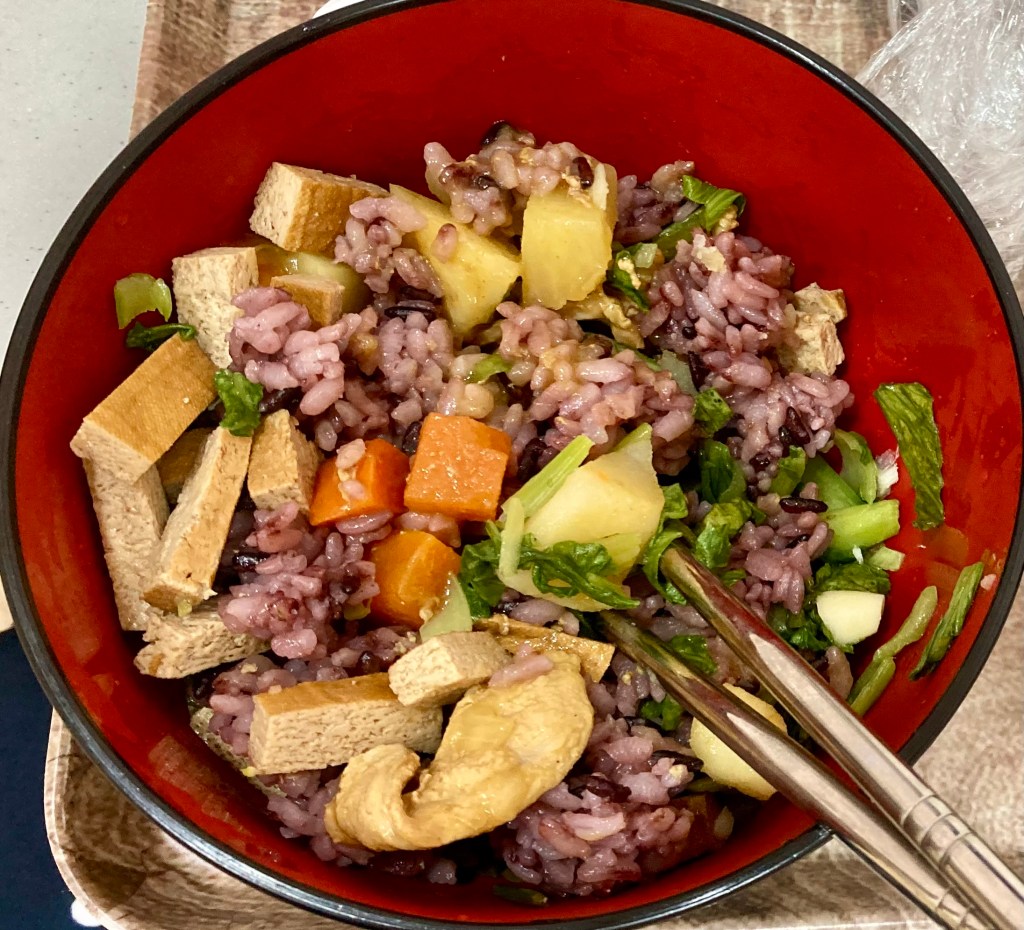
After a few hours, this cacophony of inputs started to make my stomach grumble. Fortunately, Ai-Hua mentioned that the children would soon eat lunch and invited me to share what they were having. I said yes, but imagined being given some bland food—something like what my son had eaten at his daycare, which also catered to elderly residents living next door. Instead, my eyes popped open at the sight of the meal, and my taste buds were richly rewarded. It was hard to believe that the children were eating something so delicious and simultaneously nutritious. I later found out that the person vacuuming was also the daycare’s five-star chef.
Once I had tasted this resource firsthand, I began to see it crop up in subsequent conversations with working mothers. These daycares, in-home nannies, and nannies who took children into their own homes, all cooked meals for the children. For Taiwanese families, nutritious and delicious meals are something they take for granted, like the air my family breathes in upstate New York. It wouldn’t even cross their minds to pack a lunch; whatever their child eats will be warm and fresh.
Regarding food in the US, we are a bit like the Beijing taxi driver. At my child’s daycare, I recall a little girl munching on dried ramen noodles as a snack, right out of the plastic pouch. At the very least, those noodles could have been cooked with an egg and some vegetables mixed in. And yet, we are not acculturated to that standard of a food environment. To this day, if I serve ramen noodles to my children, they refuse the egg and vegetables because, they say, it ruins the taste completely.
In Taiwan and Spain, eating well is a taken-for-granted resource. On that day, that bowl (pictured below) nourished my soul and was the most memorable meal for me during my field research.